
Why Studying Abroad May Be the Best Choice of Your Life
There is a moment in every student’s life—a moment of solitude—that sparks the question, “Is there something else out there for me?” More than classrooms. More than countless coaching centres. More than exams that seem to define you.
For thousands of Indian students, the initial “what if” becomes “why not” and then rapidly evolves into a journey that becomes so much larger than academic goals. This is travelling abroad—this is not just a decision of where to study—but a decision on how to grow, learn and view the world.
The Dream: Why So Many Indian Students Are Seeking to Study Abroad
In India, education is generally focused on a few extremely competitive entrance exams—JEE, NEET, CLAT, CUET. Millions of brilliant minds take these exams each year, sacrificing sleep, hobbies and sometimes even their own self-worth. Many go on to do incredible things, but many are left with one major question in the back of their mind: What now?
But what if it is not failing, or even doing well in an exam that is the end, but rather the unique beginning of a different journey (equally valuable)?
The reality is that the Indian education system, for all its framework and discipline, is not designed for everyone. It is intense, yes, but also rigid. Classrooms are often overcrowded, outdated curriculum, and little room for creativity, conversation, or curiosity. You are to follow the book, not question it. You are taught to recall, not to rethink. And slowly – silently dreams start to dwindle.
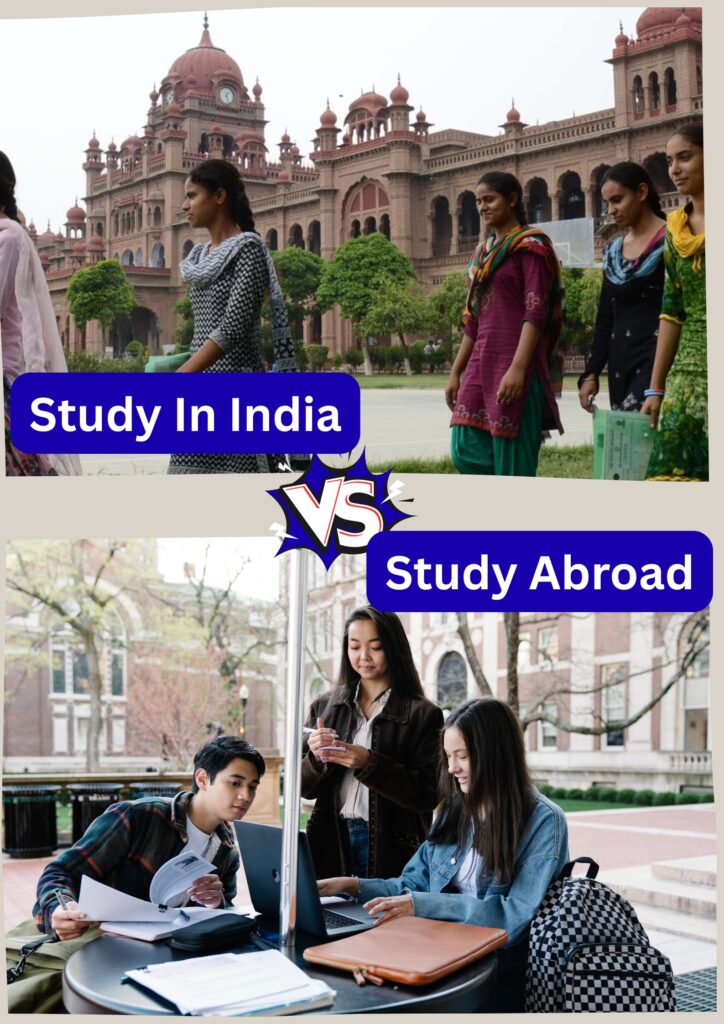
Now picture a different classroom. A classroom where the professor wants to know what you think beyond the pages of the book. Where debates and discussions are welcomed, and making mistakes doesn’t mean you need to hide them. Imagine projects where students must develop responses to actual issues, classmates who are from other countries and share ideas from other cultures, and a campus environment that is more of a community than a competition.
That is what foreign study offers, not just a credential, but a fresh lens on our world.
And that’s why a larger number of Indian students are choosing to look beyond borders. Over the course of a decade, the number has exploded. But it’s not only about foreign qualifications. It’s about freedom. It’s about discovering yourself when you are no longer constrained by exam results and social conventions.
Is Study Abroad Worth It?

This is a question that students and their families frequently ask and a fair question to ask.
Two major concerns dominate this conversation:
- Is it too expensive
- Will it really help my career?
Let’s answer both—truthfully.
Indeed, a study abroad experience can cost quite a bit, especially compared to your home-country study, like in the US, UK, Australia, and so on – but equally, there are countries who offer free, or very low-cost, higher education, like Germany – where education is free for state supported public universities; France, Italy, Norway, and Finland, can offer significant subsidization for foreign students pursuing study in their nations, and so on. Even with countries that have higher fees, there are literally thousands of scholarships in nearly every field of study – some merit-based, other need-based, and even some government sponsored or university-specific.
Most importantly, studying abroad isn’t simply an expense; it’s all about the return on investment. The question is not about “How much will I spend?” but about “How much will I make?”
Graduates from international universities tend to achieve a much higher starting salary, much more job opportunities, and are promoted faster than graduates from domestic universities. Plus they will meet people from all over the world, develop cross-cultural knowledge and skills, and build soft skills like flexibility, communication, problem-solving – all highly important skills in virtually every industry.
In fields like engineering, health care, business, data science, public policy, fashion, and even film-making, a foreign degree many times positively opens doors a domestic degree would have remained closed.
Studying Abroad vs. Studying in India: A Realistic Comparison
For most Indian students, the decision of where to study — India or abroad — is not so much about selecting a university — it’s about selecting a life. Both have their own pluses and minuses, their own set of challenges and long-term ramifications. And although neither is automatically better or worse than the other, they do provide quite different experiences.
Let us begin with the fact: India gives birth to some of the sharpest brains in the world. Our engineers, technologists, doctors, managers, and scholars are the best in the world. The nation boasts institutions of national importance such as the IITs, NITs, AIIMS, and IIMs, which have international standards and have very stringent admission criteria.
Yet, for each student who succeeds in these premier colleges, there are thousands more who don’t — not because they are unskilled, but because the competition is impossible. The emphasis on a handful of exams like JEE or NEET results in thousands of worthy candidates being left behind, after years of toil.
Conversely, foreign study provides a different type of educational experience — one that focuses more on overall development than test scores, research more than mechanical memorization, and skills over knowledge.
Here’s how the two routes usually stack up:
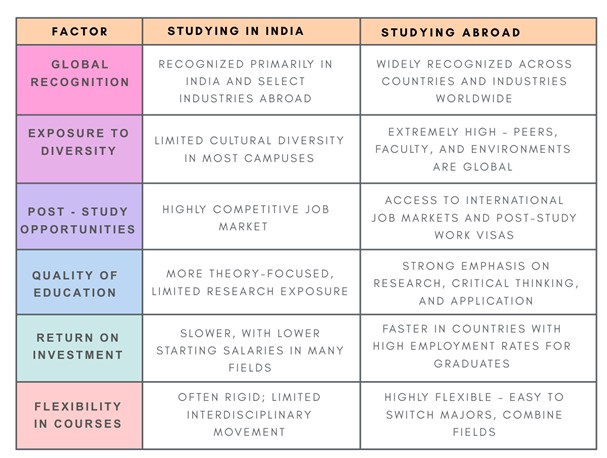
- India: Excellent in basics, particularly in math and science. But too many universities still place much emphasis on theoretical teaching, oversized lecture-based courses, and antiquated syllabi.
- Abroad: Focuses on critical thinking, research, and practical application. Class sizes tend to be smaller, discussions are encouraged, and projects are more important than written exams.
- India: Most degree programs are rigid. Once you choose a stream or specialization, it’s difficult to change direction later. Interdisciplinary learning is rare.
- Abroad: Students are encouraged to explore different subjects in the first year. You can often switch majors, combine fields (e.g., computer science + philosophy), or even design your own degree path.
- India: With engaging and competitive environments on Indian campuses, the cultural exposure is generally regional or national diversity.
- Abroad: Students meet people from dozens of countries and see the world from a much larger global perspective than they typically would. This experience creates an openness and diversity of thought that influences your mindset. Additionally, you will likely improve your cross-cultural communication skills – an immeasurably important advantage in today’s job market.
- India:There is a vast job market, but it is also extremely competitive. So competitive in fact your prospects for securing employment upon graduation will be more related to the standing of your college and how you fared on the course.
- Abroad: Most nations have post-study work visas, so you will have an opportunity of gaining some work experience from a foreign nation. Employers favor international graduates and have been known to prefer them over local graduates because they view them as independent thinkers, adaptable, and skilled.
- India: Study fees are typically far less than abroad, particularly at state schools. ROI can be longer if jobs in your industry or area are scarce.
- Abroad: Tuition fee could be higher, while the ROI might be faster because of the higher initial salary, the availability of the opportunity to work part-time, and the presence of the large global companies you could be employed by.
So, Which One to Pick?
This isn’t a comparison to label one system as “superior” to the other. Indian education has its strengths — particularly in developing academic discipline, technical know-how, and toughness. It has churned out world leaders, CEOs, scientists, and innovators.
But if you want something beyond a typical scholarly path — if you want international exposure, research work, contemporary methods of teaching, and courses that change with the times — then studying abroad can be your best bet. Also, keep in mind that going abroad to study is not a rejection of your native country — it’s broadening your horizons. Most students come back after their degrees to give back to India with new skills, ideas, and experiences that make them more effective at whatever career they pursue.
It’s your decision — your dreams, your background, and the type of future that you’d like to create. And the great thing about it? No matter which route you choose, you can make it incredible with the proper planning and attitude.
Where Can You Study? Choosing the Right Country for Your Dreams
You have many options for schooling and one of the hardest decisions you’ll make is choosing where to go. Each country has its benefits, cultures, and education systems. The factors you consider when making a decision will depend on your field of studies, budget, personal language preferences as well as long term goals. Here is a summary of the most commonly travelled study abroad destinations for students from India:
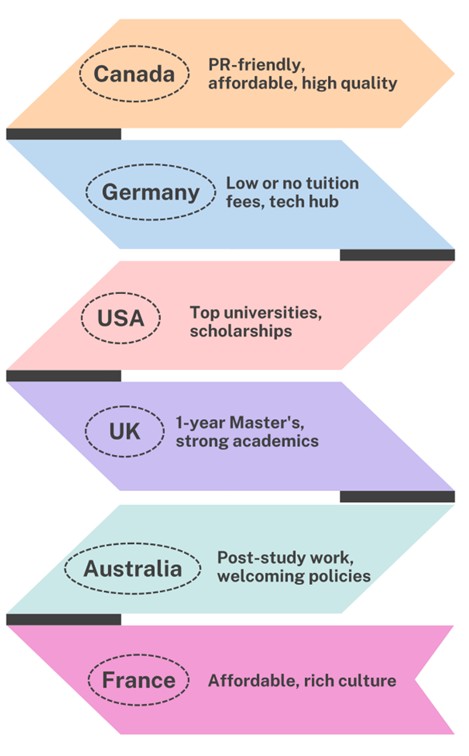
Known for its friendly culture and strict academic standards, Canada attracts students for data science, engineering, business, and medicine.. With generous post-study work visas and immigration routes, it provides quality education as well as future settlement possibilities
A tech, engineering, and innovation haven, Germany is home to tuition-free studies at public universities, including for overseas students. English-language study options are common, and the standard of living is reasonable in most towns. United States: Home to some of the world’s best universities, the US offers unmatched flexibility in education. Students can explore everything from AI to liberal arts. Although expensive, financial aid, assistantships, and part-time work options ease the burden for many.
The US boasts some of the best universities in the world, and is the only country in the world that offers students unmatched flexibility in education. Students can choose to study everything from AI to Study in the US Spirituality! The cost of studying in the US can be expensive; however, for many students, financial aid, assistantships, and part-time job options are available to alleviate some of the expenses associated with higher education
The UK has a high regard for academic history worldwide and has institutions like Oxford and Cambridge in addition to many other universities they recognize the work you can expect from them with a one-year master’s program, and very good employer recognition, in addition to scholarship programs such as Chevening and Commonwealth.
Generally considered to have a decent quality of life and offers students a more laid-back student culture. International students flock to Australia to study environmental science, hospitality, medicine, and business more than anywhere else. Australia allows students to work part-time, and also includes a post-study work visa in addition to its student working status. France: France has fast become a popular destination for Indian students due to its cheap education, courses in English, and incredibly fast-paced culture. Popular courses to study in France include fashion, culinary arts, international relations, and business management.
What’s the Real Cost of Studying Abroad?
The expense is quite variable based on the nation, course, and way of life. On average:
- Cost of tuition fees each year can be from ₹3 to ₹30 lakhs.
- Cost of living can be from ₹5 to ₹12 lakhs per year.
- Travel, visa, and application fees can be from ₹1 to ₹2 million.
And that’s just the beginning.
Most students save a lot of money through scholarships, grants, fee waivers, and part time jobs. Also, in India, education loans are tax free under Section 80E so parents basically pay no interest while repaying. In the long run, a global degree usually translates into superior jobs, which makes it a high-return investment

How the Process Works: From Dream to Departure
Studying abroad is not just a degree but an experience that widens your horizon and shapes your future. But let’s be honest—affording one can be pretty intimidating. The good news is that not only do some of the most prestigious scholarships in the world exist for students just like you, who have big dreams but little funding, but there are scholarships that are specifically for Indian students. Here’s a closer look at five of them that unlock global education opportunities:
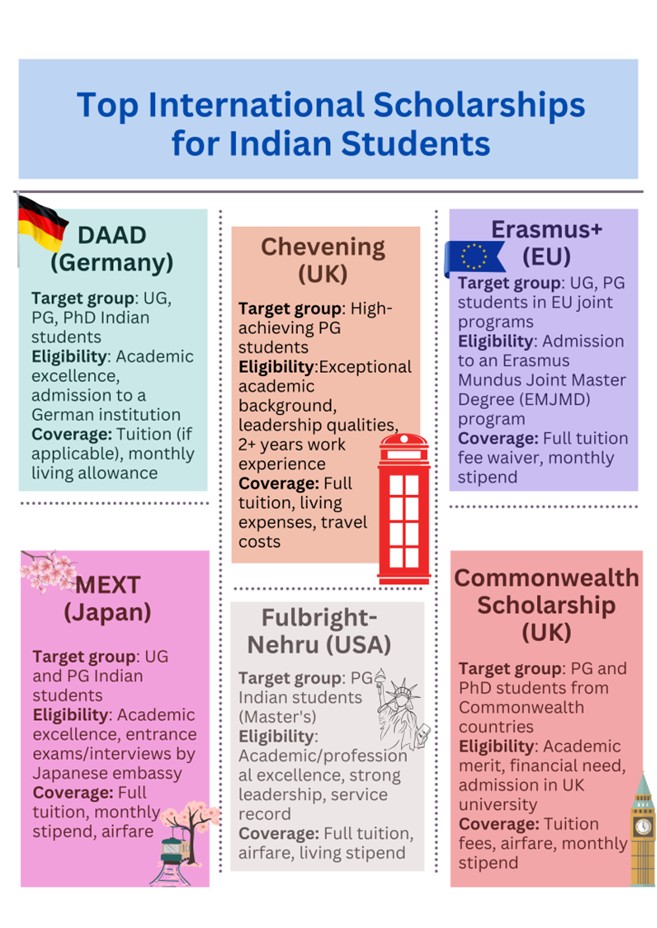
Germany is a long-standing choice for Indian students; in fact, it provides an excellence of education that is difficult to better, sometimes with no tuition, or at the least minimal fees.
Eligibility: Indian students pursuing undergraduate, postgraduate, and PhD courses in various subjects
Coverage: Tuition and living allowances
Why it distinguishes itself from the rest: DAAD’s focus on research and innovation will allow you to study at Germany’s leading public universities, and benefit from the strengthened infrastructure provided by Europe’s largest economy.
An exceptionally competitive scholarship open to extraordinary students with exceptional leadership qualities, The Chevening Scholarship is offered by the British government.
Eligibility: Indian students with academic standing and leadership record.
What coverage is being offered: All study costs – fees, living expenses & return flights
Unique Selling Point: This is not just one scholarship. It is a community of leaders. Chevening alumni become world leaders in their fields and governments
If you want to study in more than one country as part of your course, Erasmus+ is the best option.
Eligibility: Applicants to double programmes with more than one EU institution
Coverage: Tuition fees and monthly living allowance
What makes it special: The mobility schemes enables students to participate in exciting opportunities by studying and living across different countries in Europe during their studies, providing a truly multicultural, cross-discipline experience.
The Fulbright-Nehru is a collaborative effort between the India and USA governments to foster mutual understanding and global citizenship throughstudent exchange and scholarships between the two nations.
Eligibility: Indian students at the postgraduate level from a wide variety of fields.
Coverage: Coverage: Tuition, and airfare globally.
What is special about it: The scholarship presents an opportunity for students to continue studying at prestigious universities.
The MEXT (Monbukagakusho) scholarship provides funding from the Japanese Ministry of Education and is a fully financed scholarship for international students.
Eligibility: Indian students (undergraduate and postgraduate)
Coverage: Full fees, monthly stipend and cost of living during travel to Japan.
Why it is unique: MEXT invites students to discover Japan’s globally renowned learning centers and distinctive culture, particularly in engineering, technology, and robotics
The Best International Scholarships for Indian Students: Your Guide to Global Education
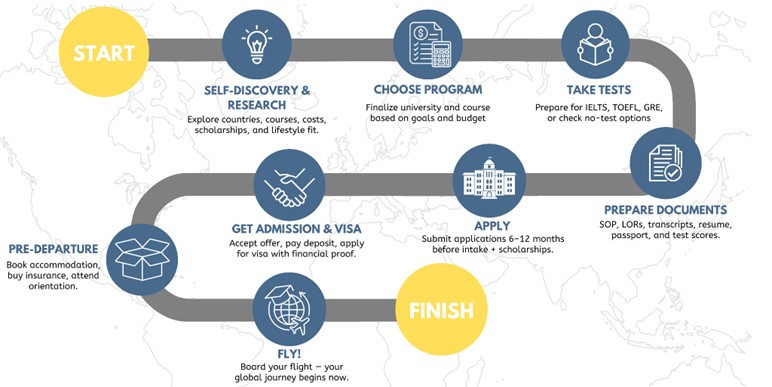
Planning to study abroad can be overwhelming at first glance, but once you break down the process into steps, you will find it easy to manage .
Here is what the process usually looks like:
- Research Your Options: Determine the top countries, courses, and universities based on your objectives.
- Check Eligibility: Check academic needs, entry exams, language tests, and application deadlines.
- Study for Exams: You may have to prepare for exams like IELTS, GRE or GMAT.
- Collect the Documents: academic transcript, SOP, LORs, financial documents, passport, etc.
- Apply to Universities: Applications start 6–12 months prior to your preferred intake.
- Receive Offer Letters: After acceptance, you get unconditional or conditional offers.
- Apply for Visa: Submit your visa application along with supporting financial information and biometric details.
- Book Travel and Fly Out: Arrange housing, purchase plane tickets, and prepare for living abroad..
Every student’s journey is different—and so and so does his or her support.
Why Guidance Is Important: Selecting the Correct Consultancy
This is where a trusted study abroad consultancy steps in.
Many students miss out on golden opportunities—not because they lack talent, but because they lack direction. Forms are complex, deadlines are confusing, and financial planning can be stressful.
At Dronaa International, the goal isn’t to send you to any university. It’s to send you to the right one. Whether you’re a top scorer or someone looking for a second chance after a tough exam year, Dronaa International helps you build a personalized profile, choose the best-fit course, and navigate the entire application-to-visa journey.
They become your partners—not just until takeoff, but even after you land.
The Final Word: Studying Abroad Is Not a Luxury—It’s a Choice for the Brave
The majority of the students are losing golden chances—not due to lack of talent, but due to lack of guidance. The applications are complicated, deadlines are unclear, and budgeting is anxiety-provoking.
At Dronaa International, it’s not a question of getting you into any university. It’s a question of getting you into the right one. You’re a high achiever or you flunked a difficult year of exams and deserve a second chance – Dronaa helps you develop your own bespoke profile, choose the most appropriate course, and take you through the whole application-to-visa process.
They are your partners—not only until you leave, but even once you have arrived. The. Last. Word. Learning. Abroad. Is. Not. a. Privilege—it’s. an. Option. for. the. Daring.
In the past, international education was the privilege of the rich and the wealthy alone. But times have changed. Students from small towns in India, middle class students, are now availing global degrees on full scholarships. They’re establishing businesses, conducting research, and re-writing the narrative on Indian talent on the global canvas.
So, if you’ve been curious—this is your sign. Foreign travel is not for the elite. It’s for the ready. It’s for the dreamers, the doers, and for those who believe that their worth is more than a test score. Because when you go abroad to learn, you don’t just earn a degree. You gain insight. You gain wings.
And most importantly, you discover a piece of yourself that you never even knew existed.

Author- Ms Haizel Garg
Studying abroad, for me, has always been more than just earning a degree—it’s about discovering who I am and who I can become. Stepping into a new country means embracing independence, facing challenges, and growing in ways I never imagined. It’s about learning to cook, manage money, and find my way through unfamiliar streets, all while building confidence and resilience. The journey, however, isn’t easy. Between paperwork, tests, and uncertainty, it can feel overwhelming. That’s where Dronaa International changed everything for me. They didn’t just help with forms or university options—they understood my dreams. Their mentors took the time to listen, to ask why I wanted to study abroad, and to guide me through each step, from test prep to visa support. They helped me tell my story with honesty and clarity, not by rewriting it, but by helping me see its value. Studying abroad has taught me patience, adaptability, and gratitude. I’ve learned to appreciate the little things—a call from home, a familiar meal, a kind gesture. Meeting people from different cultures has made me more open, curious, and compassionate. If you’ve ever dreamed of studying abroad but don’t know where to begin, take it from me—start with Dronaa International Dehradun. They prepare you not only for university but for life beyond it. Because with the right direction, there’s no boundary you can’t cross.
